
CAT 2026 Exam Preparation : Full Guide, Strategy & Topper Tips
Last Updated:
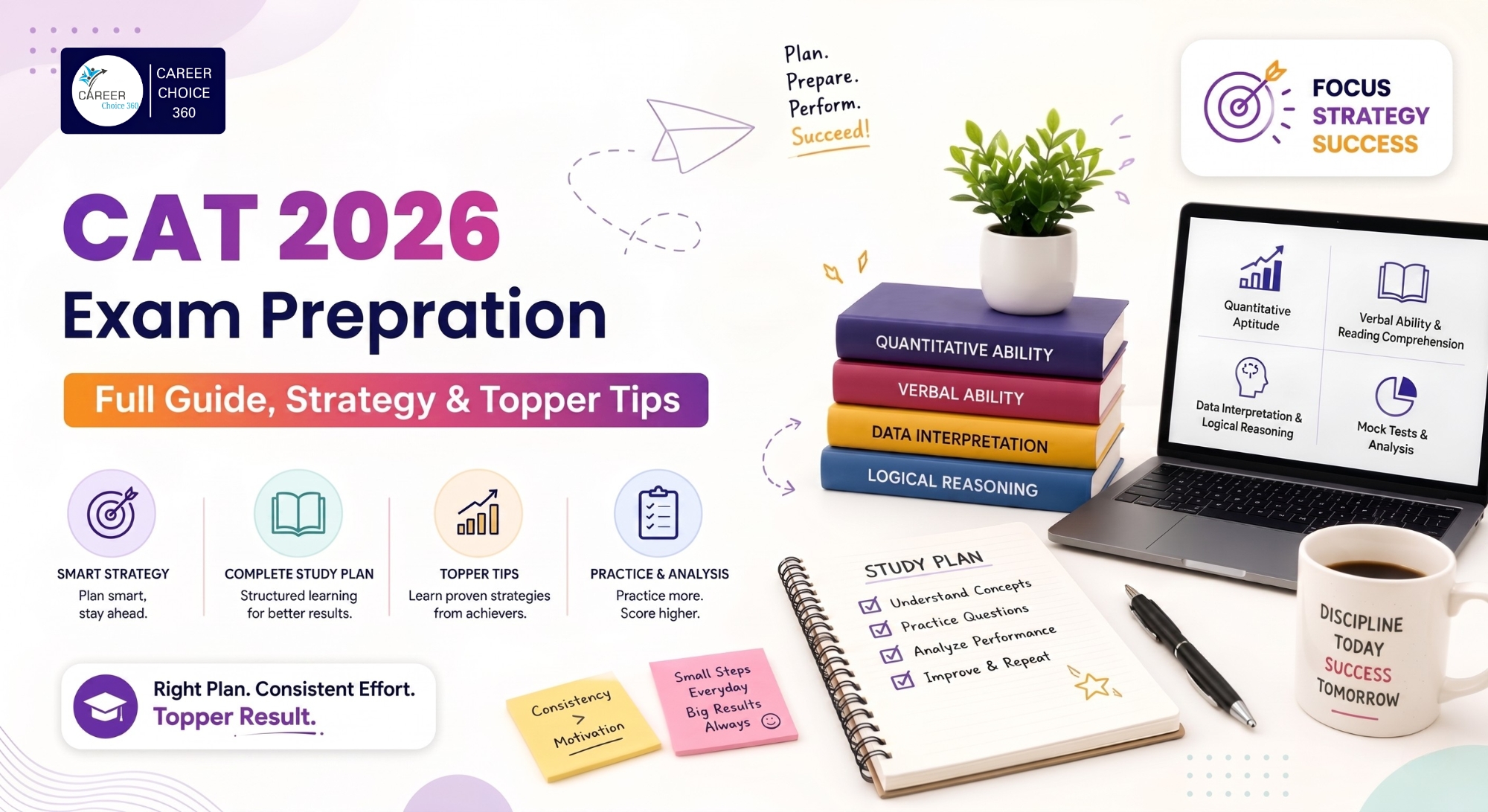



If cracking
CAT 2026
is on your radar, the best time to start your CAT 2026 preparation is right now – not next month, not after your semester gets over. It is one of the most competitive MBA entrance exams in India with over 3 lakh students competing for seats in IIMs and top B-schools. The difference between those who succeed and those who fail is frequently one thing: strategy.
This full guide is collated with tips and tricks from
CareerChoice360
that includes how to prepare for the CAT exam, the proper books, a smart 6 months study schedule and real topper techniques that work.
Know the CAT 2026 Exam Pattern First
Before creating your CAT 2026 preparation strategy, it is important to understand the exam pattern thoroughly.
| Section | Questions | Time Limit |
|---|---|---|
| VARC (Verbal Ability & Reading Comprehension) | 24 | 40 Minutes |
| DILR (Data Interpretation & Logical Reasoning) | 20 | 40 Minutes |
| QA (Quantitative Aptitude) | 22 | 40 Minutes |
- Total exam duration is 120 minutes.
- Each section has a fixed time limit of 40 minutes.
- Candidates cannot switch between sections during the exam.
- MCQs carry a negative marking of −1 mark for every incorrect answer.
- TITA (Type In The Answer) questions do not have any negative marking.
Once you understand the CAT exam pattern, it becomes much easier to design an effective preparation plan and allocate your study time wisely.
CAT 2026: 6 Month Study Plan - Month Wise Distribution
A well-planned CAT 2026 six-month study plan is the backbone of a serious aspirant’s preparation journey. The following roadmap can help you structure your preparation effectively and maximize your score.
Month 1 & 2 – Lay the Foundation
This phase is all about building strong fundamentals. One of the biggest mistakes aspirants make is jumping directly into mock tests without understanding the basics.
- QA: Start with Arithmetic topics such as Percentages, Ratios, Time-Speed-Distance, and Profit & Loss, which account for a significant share of Quant questions.
- VARC: Read editorials and long-form articles daily from sources such as The Hindu, The Economist, and Aeon Essays to improve reading speed and comprehension.
- DILR: Practice basic Data Interpretation sets including Tables, Bar Charts, and Pie Charts along with simple logical puzzles.
- Daily Study Goal: 3–4 hours on weekdays and 5–6 hours on weekends.
Month 3 & 4 – Dig Deeper, Find Weak Spots
- Cover major concepts from Algebra, Geometry, Number System, and Modern Mathematics.
- Start solving full-length VARC passages under timed conditions.
- Move from basic to intermediate DILR topics such as Seating Arrangements, Constraint-Based Sets, and Games & Tournaments.
- Begin sectional mock tests and attempt at least one sectional mock every week.
- Maintain an error journal to track mistakes, identify weak areas, and revise concepts regularly.
Month 5 – Mock Test Increase
This is the stage where your preparation starts translating into actual CAT performance.
- Take 2 full-length mock tests every week.
- Spend more time analyzing mocks than attempting them. A 3-hour mock should ideally be followed by 2–3 hours of analysis.
- Track percentile improvement separately for VARC, DILR, and QA.
- Avoid learning entirely new topics unless they represent a major weakness.
Month 6 – Revision & Refining
- Increase the frequency to 3 mock tests per week during the final three weeks.
- Revise formula sheets, shortcuts, and quick-solving techniques regularly.
- Focus on accuracy over speed, as CAT rewards quality attempts more than quantity.
- Simulate actual exam conditions while taking mocks by following the same time slot and avoiding distractions.
Books Used by Toppers For CAT Preparation
Choosing the right CAT preparation books can save months of effort and help you focus on the concepts that matter most. Below is a carefully selected list of books frequently recommended by CAT toppers and mentors.
For Quantitative Aptitude (QA)
- Quantitative Aptitude for CAT by Arun Sharma – Widely regarded as the gold standard for CAT Quant preparation.
- How to Prepare for Quantitative Aptitude for CAT by Arun Sharma & Meenakshi Upadhyaya.
For Verbal Ability & Reading Comprehension (VARC)
- How to Prepare for Verbal Ability and Reading Comprehension by Arun Sharma & Meenakshi Upadhyay.
- Word Power Made Easy by Norman Lewis – Highly recommended for vocabulary building and language improvement.
For Data Interpretation & Logical Reasoning (DILR)
- How to Prepare for Data Interpretation by Arun Sharma.
- Logical Reasoning and Data Interpretation for CAT by Nishit K. Sinha.
Additional Resources
- Previous Year CAT Question Papers (2015–2024): Essential for understanding question patterns and difficulty levels.
- Mock Tests: Practice test series from IMS, TIME, and Career Launcher.
Preparation Tips for Sectional CAT 2026
How to Prepare for CAT VARC Section
VARC is less about vocabulary and more about comprehension, reasoning, and understanding arguments. Consistent reading and analytical thinking are the keys to improving this section.
- Read across multiple genres such as fiction, science, philosophy, economics, and social sciences. CAT Reading Comprehension passages can come from any domain.
- Focus on inference-based questions rather than only factual details.
- For Verbal Ability topics such as Para Jumbles, Odd Sentence Out, and Para Summary, rely on logical structure rather than intuition.
- Instead of memorizing answers from question banks, try to understand the author's intent and line of reasoning.
How to Prepare for CAT DILR
DILR has often been one of the highest-scoring sections for well-prepared candidates. Smart selection of questions is just as important as problem-solving ability.
- Practice a wide variety of Data Interpretation sets and Logical Reasoning puzzles.
- During mock tests and the actual exam, spend the first few minutes selecting the most approachable sets.
- A fully solved 4-question set is generally more valuable than partially solving a larger set.
- Regularly practice under timed conditions to develop speed and decision-making skills.
How to Prepare for CAT QA
Quantitative Aptitude rewards conceptual clarity and accuracy more than sheer speed. A strong foundation is essential before focusing on shortcuts and advanced techniques.
- Master the fundamentals of each topic before learning shortcut methods.
- Learn multiple approaches for solving questions, as different methods may work better for different problem types.
- For Geometry and Number System topics, focus on visualization and concept-building rather than memorizing formulas alone.
- To target a 99+ percentile, focus on maximizing accuracy. Attempting around 22–26 questions correctly is often more effective than trying to solve every question.
CAT 2026 Topper Tips: What Sets Apart the High Scorers
Based on insights from CareerChoice360 and consistent trends observed in topper interviews over the years, the following habits and strategies are commonly followed by candidates who score in the 99+ percentile range.
-
Mock Analysis Matters More Than Mock Quantity
Toppers do not necessarily attempt the highest number of mock tests. Instead, they analyze each mock thoroughly. Every mock provides valuable data about accuracy, time management, and recurring mistakes that can be corrected before the actual exam. -
Consistency Over Intensity
Studying for 3 focused hours every day over several months is generally more effective than studying for 10–12 hours occasionally. CAT rewards consistency and disciplined preparation. -
VARC Requires Regular Reading
Almost every 99+ percentile scorer develops a strong reading habit. Reading newspapers, editorials, and long-form articles regularly helps improve comprehension speed and accuracy. -
Create Your Own Sectional Strategy
There is no universal strategy that works for everyone. The number of questions to attempt, ideal order of solving questions, and target scores should be based on your individual strengths and weaknesses. -
Do Not Ignore DILR
Many aspirants spend most of their preparation time on Quantitative Aptitude while neglecting DILR. In recent CAT exams, DILR has often been the section that significantly impacts overall percentile, making it equally important. -
Sleep and Health Matter
Top performers treat CAT preparation like athletes preparing for a major competition. Maintaining good health, exercising regularly, and getting 7–8 hours of sleep can improve concentration and prevent burnout during the final months of preparation.
Quick CAT 2026 Prep Checklist
- Master the fundamental concepts of QA, VARC, and DILR by the end of Month 2.
- Start sectional practice tests and topic-wise mock tests during Month 3.
- Take full-length mock tests and perform detailed mock analysis throughout Months 4 and 5.
- Read at least one high-quality article, editorial, or long-form essay every day during your preparation.
- Review your error log every week to identify recurring mistakes and weak areas.
- Use Month 6 primarily for revision, mock simulations, and final fine-tuning of your exam strategy.
Conclusion
CAT 2026 is completely achievable with the right preparation strategy, reliable study resources, and the discipline to stay consistent throughout your journey. Start early, focus on building strong fundamentals, and let insights from your mock test performance guide your preparation decisions rather than emotions. With a structured study plan, regular practice, and continuous improvement, you can significantly enhance your chances of securing a top percentile. Stay connected with CareerChoice360 for the latest CAT 2026 updates, expert preparation tips, study plans, and resources designed to help you approach the exam with confidence.