
CAT 2026 Syllabus (VARC, DILR & Quant): Check Topics-wise Weightage
Last Updated:
CAT exam syllabus 2026
Preparing for the CAT Exam 2026 requires a thorough grasp of the syllabus and continuous practice on different subjects. The exam covers a wide variety of concepts and candidates need to develop strong analytical reasoning, understanding and reading abilities to be able to pass the exam.
The CAT syllabus is mostly focused on the following areas: Verbal Ability and reading Comprehension (VARC), Data Interpretation & Logical Reasoning (DILR) as well as the Quantitative Aptitude (QA). These sections are intended to assess a candidate's problem-solving capacity, logical thinking and communication abilities.
It is interesting to note that it is interesting to note that the syllabus of the CAT exam remains largely the same since the test began. So, those who plan to sit for the CAT in 2026 should begin their preparations as early as June 2026 giving themselves sufficient time to finish the syllabus and thoroughly revise.
The test for CAT 2026 is scheduled to take place on the 29th of November in 2026.. Below is a comprehensive description of the syllabus for CAT including section-wise topics as well as weightage and recommended books.
CAT 2026 Syllabus Highlights
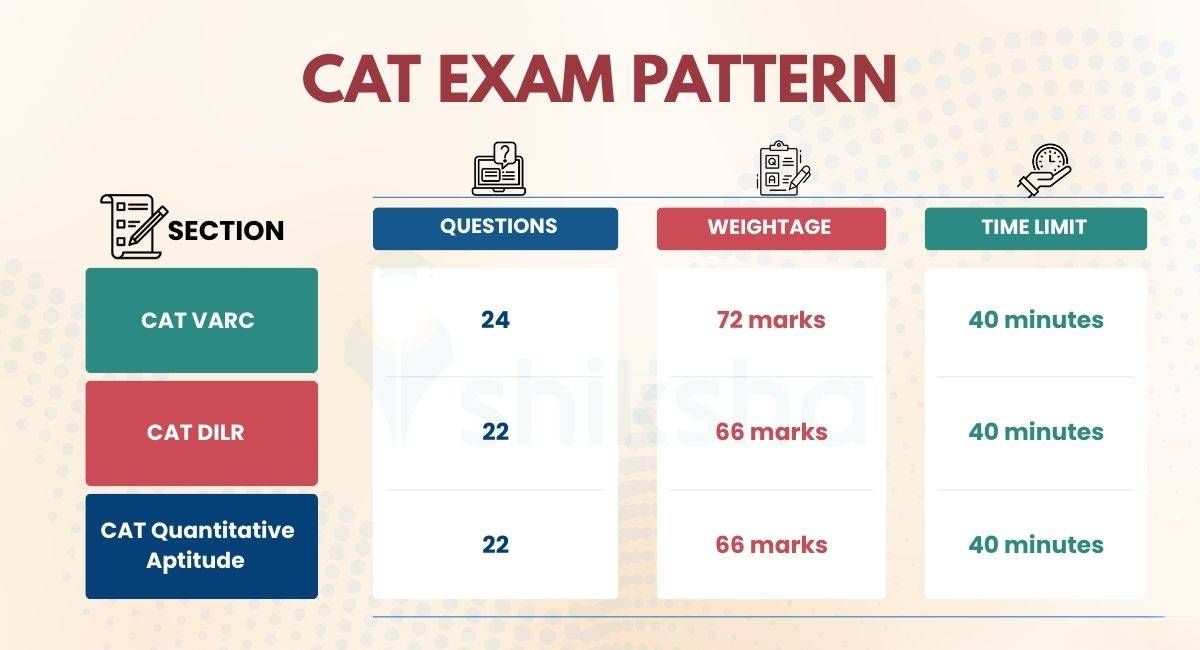
The CAT is regarded as one of the top entrance exams for management in India. Knowing the structure of the exam can help candidates plan their preparation more efficiently and understand the distribution of questions and marks across sections.
| CAT Exam Particulars | Details |
|---|---|
| Number of Sections | VARC, DILR, Quantitative Aptitude |
| Questions in VARC | 24 |
| Questions in DILR | 22 |
| Questions in Quantitative Aptitude | 22 |
| Marks in VARC | 72 |
| Marks in DILR | 66 |
| Marks in Quantitative Aptitude | 66 |
| Question Types | MCQ and TITA (Type In The Answer) |
CAT VARC Syllabus 2026
The VARC section of the CAT exam is mainly based on reading passages and focuses on comprehension and interpretation skills. Unlike many other competitive exams, CAT usually does not include direct vocabulary or grammar questions.
Candidates need to regularly practice reading complex passages and develop the ability to understand arguments, tone, and context. Strong analytical reading skills play an important role in performing well in this section.
| Section | Topics | Questions (out of 24) | Weightage |
|---|---|---|---|
| Reading Comprehension | Inference based questions, specific detail questions, application/purpose questions, logical reasoning questions | 16 | 67% |
| Para Jumbles | The arrangement of sentences to create an effective paragraph | 3 | 12.5% |
| Para Summary | Selecting the best sentence that sums up a paragraph | 3 | 12.5% |
| Odd Sentence | Recognizing the phrase that doesn't match the sentence | 2 | 8.3% |
Read More: CAT 2026 VARC Strategy to Score 30+ Marks & Get 95+ Percentile
CAT DILR Syllabus 2026
The DILR section combines Data Interpretation and Logical Reasoning. Questions are usually presented in sets, and solving them requires strong analytical thinking, logical reasoning, and the ability to interpret numerical data efficiently.
| Data Interpretation Topics | Logical Reasoning Topics |
|---|---|
| Caselets | Seating Arrangements |
| Percentages and Ratios | Blood Relations |
| Averages and Weighted Averages | Direction Sense |
| Profit and Loss | Syllogisms |
| Growth Rates | Clocks and Calendars |
| Data Comparison | Coding-Decoding |
| Venn Diagrams | Number Series |
| Tables and Charts | Logical Sequences |
| Graphs and Networks | Puzzles |
| Mathematical Data Sets | Games and Tournaments |
Read More: CAT 2026 DILR Strategy to Score 26+ Marks & Get 95+ Percentile
CAT Quantitative Aptitude Syllabus 2026
The Quantitative Aptitude section mainly tests mathematical concepts that candidates have studied in school-level mathematics. The questions evaluate numerical ability, problem-solving skills, and logical application of mathematical formulas.
The syllabus can broadly be divided into five major areas including Arithmetic, Algebra, Geometry, Number System, and Modern Mathematics. Each area carries a different weightage in the exam.
| Section | Topics | Questions (out of 22) | Weightage |
|---|---|---|---|
| Arithmetic | Percentages, Ratio & Proportion, Profit & Loss, Simple & Compound Interest, Averages, Mixtures, Time-Speed-Distance, Time & Work, Pipes & Cisterns, Boats & Streams, Partnerships | 8-10 | 40% |
| Algebra | Functions, Logarithms, Linear & Quadratic Equations, Inequalities, Sequences & Series, Polynomials, Progressions (AP, GP, HP), Maxima & Minima | 5-7 | 30% |
| Geometry | Triangles, Circles, Quadrilaterals, Lines & Angles, Polygons, Mensuration, Coordinate Geometry, Trigonometry | 1-3 | 15% |
| Number System | Integers, Natural Numbers, Real Numbers, Division Remainders, HCF and LCM, Prime Numbers, Cyclicity, Factorials, Base System, Surds and Indices | 1-2 | 5-7% |
| Modern Mathematics | Probability, Permutation & Combination, Set Theory, Venn Diagrams, Binomial Theorem, Functions and Graphs | 2-4 | 5-7% |
CAT 2026 Syllabus PDF Download
Candidates can download the CAT 2026 syllabus PDF to get a complete overview of the exam pattern and important topics. The syllabus document helps aspirants plan their preparation effectively and understand the structure of the exam.
| CAT 2026 Syllabus PDF | Download |
|---|---|
| CAT 2026 Complete Syllabus PDF | Click Here to Download |
Best Books for CAT 2026 Preparation
Choosing the right study material is very important to cover the CAT syllabus effectively. Below are some of the most recommended books for each section of the CAT exam.
Best Books for VARC
- How to Prepare for Verbal Ability and Reading Comprehension for CAT - Arun Sharma & Meenakshi Upadhyay
- Verbal Ability and Reading Comprehension for CAT - Nishit Sinha
- Word Power Made Easy - Norman Lewis
- High School English Grammar and Composition - Wren & Martin
- 30 Days to a More Powerful Vocabulary - Wilfred Funk & Norman Lewis
Best Books for DILR
- A Modern Approach to Logical Reasoning - RS Aggarwal
- How to Prepare for Logical Reasoning for CAT - Arun Sharma
- How to Prepare for Data Interpretation for CAT - Arun Sharma
- Logical Reasoning and Data Interpretation for CAT - Nishit Sinha
- CAT Data Interpretation & Logical Reasoning - Gautam Puri
Best Books for Quantitative Aptitude
- NCERT Mathematics (Class 9 & 10)
- How to Prepare for Quantitative Aptitude for CAT - Arun Sharma
- Quantitative Aptitude for Competitive Examinations - Abhijit Guha
- Quantum CAT - Sarvesh Verma
- Quantitative Aptitude for CAT - Nishit Sinha
- Quantitative Aptitude - RS Aggarwal
CAT 2026: Ideal Number of Attempts
Since the CAT exam is time-bound, candidates must focus on accuracy along with speed. Aspirants aiming for 99+ percentile should attempt a reasonable number of questions in each section while maintaining good accuracy.
| Section | Total Questions | Good Attempts |
|---|---|---|
| VARC | 24 | 14-16 |
| DILR | 22 | 10-11 |
| Quantitative Aptitude | 22 | 10 |
| Total | 68 | Around 36 |
CAT 2026 Preparation Tips
Start by building strong conceptual clarity in each subject and then move to regular practice through mock tests and previous year CAT question papers. Consistent practice, proper time management, and performance analysis are the key factors for achieving a high percentile in the CAT exam.
 Enter Details to Download PDF