
MBA After BSc: Eligibility, Specialisations, Career Options, Salary
Last Updated:
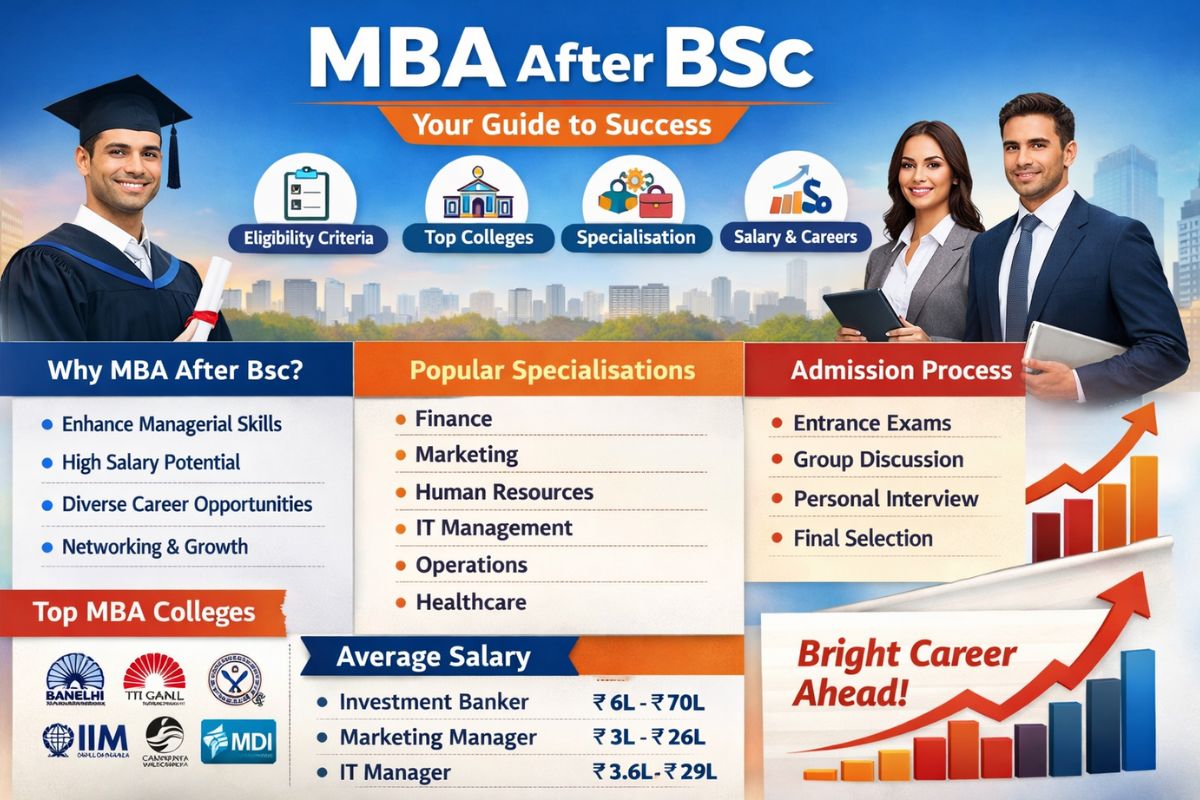
MBA After BSc
Many students feel lost after they've completed their BSc degree on what to follow following. Some opt for MSc or technical degrees however, many science graduates are choosing an MBA to broaden their professional possibilities. If you're wondering if going for an MBA following a BSc is the best option this comprehensive guide will provide you with the eligibility requirements, fees, admission procedure, specialisations, salary prospects, and the best colleges.
What’s an MBA After BSc?
An MBA (Master of Business Administration) after completing a BSc allows science graduates to transition from technical expertise into leadership and management roles. This degree helps bridge the gap between scientific knowledge and business strategy, creating diverse career opportunities across multiple industries.
Science graduates typically possess strong analytical thinking, logical reasoning, and problem-solving abilities. When these strengths are combined with managerial skills such as finance, marketing, operations, and human resource management, they become highly valuable professionals sought after by employers.
Why Choose to Pursue MBA After BSc?
Choosing to pursue an MBA after BSc can be a strategic career move for science graduates who want to expand their professional scope beyond technical roles. Here are the key benefits:
- Enhances leadership and managerial capabilities
- Expands career opportunities beyond technical positions
- Increases potential for higher salary packages
- Provides strong networking opportunities
- Opens doors to leadership and executive roles in the corporate sector
Graduates from reputed institutions such as IITs and Indian Institutes of Management (IIMs) often secure top positions in leading multinational companies and prestigious organizations.
MBA Following BSc – Eligibility Criteria
To pursue an MBA after completing a BSc, candidates must meet the following eligibility requirements:
- An undergraduate degree (BSc) from a recognized university
- Minimum 50% aggregate marks (45% for reserved categories in some institutions)
- A valid score in MBA entrance exams such as CAT, MAT, CMAT, XAT, or GMAT
- Some private colleges may offer direct admission based on merit
MBA After BSc – Specialisations
MBA programs offer a wide range of specialisations. Students should choose based on their career goals and academic background.
- MBA in Finance
- MBA in Marketing & Sales
- MBA in Human Resource Management
- MBA in Operations Management
- MBA in Information Technology
- MBA in International Business
- MBA in Healthcare Management
- MBA in Entrepreneurship
Students with BSc backgrounds in Physics, Mathematics, IT, or Statistics often prefer Finance, Analytics, or Operations specialisations.
MBA After BSc – Career Scope & Salary
MBA graduates with a science background are in high demand across industries such as finance, IT, consulting, healthcare, manufacturing, and e-commerce.
| Job Role | Average Salary (India) |
|---|---|
| Investment Banker | ₹6 – ₹70 LPA |
| Financial Analyst | ₹6 LPA+ |
| Marketing Manager | ₹3 – ₹26 LPA |
| HR Manager | ₹3 – ₹19 LPA |
| IT Manager | ₹3.6 – ₹29 LPA |
| Operations Manager | ₹3.4 – ₹22 LPA |
Salaries vary based on institute reputation, specialization, skills, and work experience.
MBA Following BSc – Application Procedure
- Appear for MBA Entrance Exams (CAT, MAT, XAT, GMAT, etc.)
- Shortlisting based on academic performance and exam scores
- Group Discussion (GD)
- Personal Interview (PI)
Top B-schools evaluate candidates on leadership qualities, communication skills, and problem-solving ability.
Top MBA Colleges in India for BSc Graduates
- IIM Ahmedabad
- IIM Bangalore
- IIM Kozhikode
- IIT Delhi (Department of Management Studies)
- IIM Lucknow
- IIM Calcutta
- IIM Indore
- MDI Gurgaon
- XLRI Jamshedpur
MBA tuition fees at top institutions typically range between ₹12 lakh to ₹27 lakh.
Final Thoughts
Pursuing an MBA after BSc can be a transformational decision for science graduates aiming for management careers. While a BSc provides strong technical and analytical skills, an MBA enhances leadership abilities, business knowledge, and earning potential.
To maximize ROI, choose the right specialization, evaluate fee structures carefully, and aim for reputed institutions. With proper planning and preparation, an MBA after BSc can significantly accelerate career growth.
 Enter Details to Download PDF