
NMAT 2026: 5-Month Strategy, Preparation Tips, Important Topics & Recommended Books
Last Updated:
NMAT by GMAC is one of India's most widely accepted MBA entrance examinations, conducted annually by the Graduate Management Admission Council (GMAC). The exam consists of 108 questions to be completed in 120 minutes across three sections—Language Skills, Quantitative Skills, and Logical Reasoning. With no negative marking and the flexibility to take the exam up to three times in a testing cycle, NMAT offers candidates multiple opportunities to improve their scores. For the 2026 admission cycle, more than 70 leading B-schools in India and abroad accept NMAT scores for MBA and PGDM admissions, including NMIMS Mumbai, TAPMI Manipal, K J Somaiya Institute of Management, XIM University, Great Lakes Institute of Management, and several other reputed institutes. NMAT Registration 2026 is scheduled to begin on August 20, 2026, while the NMAT Exam 2026 will be conducted from November 2 to December 20, 2026. Read the article below for complete details on the NMAT 2026 exam, including registration, eligibility, syllabus, exam pattern, important dates, fees, participating colleges, and the admission process.
NMAT 2026 Important Dates
NMAT Exam 2026 will be conducted from November 2, 2026, to December 20, 2026. Candidates should keep track of the complete registration, scheduling, rescheduling, retake, and exam timelines mentioned below.
| Event | Official Schedule |
|---|---|
| NMAT Registration Starts | Thursday, August 20, 2026 |
| NMAT Registration Last Date | Saturday, October 10, 2026 |
| Scheduling Window | August 20 – October 22, 2026 |
| Rescheduling Window | August 20 – December 17, 2026 |
| NMAT Exam Window | November 2 – December 20, 2026 |
| Retake Registration | November 3 – December 17, 2026 |
| Retake Scheduling | November 3 – December 17, 2026 |
| Scorecard Availability | Within 48 Hours of the Exam |
Note: NMAT by GMAC allows candidates to schedule, reschedule, and retake the examination within the official testing window. Candidates are advised to complete the registration process as early as possible to secure their preferred exam date, test centre, and time slot.
NMAT 2026 Exam Pattern and Marking Scheme
NMAT exam is a computer-based test with 108 MCQs across three sections, each with a strictly enforced time limit and no negative marking. Check the table below for a complete explanation.
| Section | Number of Questions | Time Allotted | Marks per Question |
|---|---|---|---|
| Language Skills | 36 | 28 minutes | +3 |
| Quantitative Skills | 36 | 52 minutes | +3 |
| Logical Reasoning | 36 | 40 minutes | +3 |
| Total | 108 | 120 minutes | — |
NMAT 2026 Syllabus: Section-Wise Topics
GMAC does not release an official NMAT syllabus document, but based on previous years' papers and expert analysis, the section-wise topics remain largely consistent. Tabulated below is a detailed overview of the NMAT Syllabus 2026.
| Section | Key Topics | Questions | Time |
|---|---|---|---|
| Language Skills | Reading Comprehension, Vocabulary, Grammar, Para Jumbles, Synonyms, Antonyms, Sentence Correction, Fill in the Blanks | 36 | 28 mins |
| Quantitative Skills | Arithmetic, Algebra, Geometry, Probability, Data Interpretation, Number Systems, Percentages, Profit & Loss | 36 | 52 mins |
| Logical Reasoning | Blood Relations, Seating Arrangements, Syllogisms, Critical Reasoning, Coding-Decoding, Statement-Assumption | 36 | 40 mins |
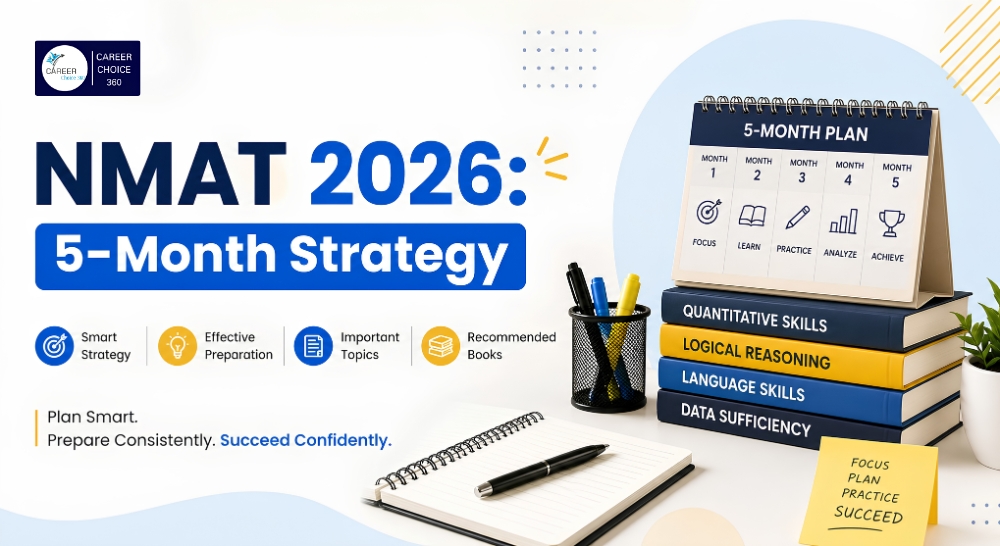
5-Month NMAT Preparation Strategy (July – November 2026)
Structured below is a 5-month strategy for NMAT 2026.
Month 1 (July): Build Your Foundation
Start with the NMAT syllabus and diagnose where you stand. Take one full-length NMAT mock test without preparation—your baseline score tells you where to focus first.
- Spend the first two weeks on Quantitative basics: arithmetic, percentages, ratios, and algebra
- Begin vocabulary building: 10–15 new words daily
- Practice basic reasoning puzzles — blood relations, directions, series
- Don't rush. Month 1 is about concepts, not speed.
Month 2 (August): Complete the syllabus + NMAT registration
This is the month NMAT Registration 2026 opens. Register early—slots fill up fast, especially for preferred centers and dates. Keep track of the NMAT registration last date to avoid missing the window.
- Cover remaining Quant topics: geometry, probability, data interpretation
- Work through Reading Comprehension passages daily (2–3 passages)
- Practice Logical Reasoning: seating arrangements, syllogisms, critical reasoning
- Take 1 sectional test per week
Month 3 (September): Increase Speed & Accuracy
The NMAT exam is a speed test. The goal this month is building the reflex to answer questions quickly without sacrificing accuracy. This is also the right time to study the NMAT exam pattern closely and align your practice accordingly.
- Shift from concept practice to timed sectional tests
- Attempt full NMAT mock tests every weekend
- Track your time per question in Quantitative Skills—this section trips most students
- Review every mock: don't just check scores, analyse wrong answers
Month 4 (October): Full Mock Drill + Weak Area Revision
NMAT last day for registration falls this month—confirm your NMAT exam date and slot if you haven't already. At this stage, your preparation should shift entirely from learning to performance.
- Take 2–3 full-length mocks per week
- Revise weak areas identified from mock analysis
- Practice NMAT's official prep tests (Prep Test 1 is free; 2 & 3 cost ₹999 each)
- Finalise your section-attempt order strategy—most NMAT toppers recommend starting with Language Skills or Logical Reasoning
Month 5 (November): Final Revision + Exam Execution
The NMAT exam date window opens in November. If you've scheduled your exam for early November, this month is pure revision and mental preparation. Focus on hitting your target NMAT score consistently across mocks before exam day.
- No new topics — only revision and mock practice
- Simulate actual exam conditions: same time slot, no distractions
- Work on your pacing: aim for roughly 47 seconds per question in Language Skills, 87 seconds in Quantitative Skills, and 67 seconds in Logical Reasoning
- Get your admit card ready—it is released 7 days before your scheduled NMAT exam
Section-Wise NMAT Preparation Tips
NMAT exam allocates 28 minutes for Language Skills, 52 minutes for Quantitative Skills, and 40 minutes for Logical Reasoning—making time management within each section as important as conceptual knowledge. Refer to the section-wise NMAT Preparation Tips 2026.
Language Skills
This section of the NMAT syllabus is the quickest to improve with consistent effort. Read editorials from The Hindu or Economic Times daily to build reading speed and comprehension naturally. Focus heavily on vocabulary and grammar rules — these fetch quick marks and directly impact your NMAT score. For reading comprehension, practice identifying the central idea before evaluating the answer options. Candidates aiming to meet the NMAT cutoff for top colleges must treat language skills as a scoring opportunity, not just a formality.
Quantitative Skills
The most calculation-heavy section of the NMAT exam. Memorize tables up to 20, squares up to 30, and cubes up to 15—this alone saves 30–40 seconds per question and significantly improves your speed across the section. Data interpretation sets appear frequently in the NMAT exam pattern; practice reading charts, graphs, and tables under time pressure. Since this section carries the longest time limit at 52 minutes, smart candidates use it to maximize their sectional score and stay above the NMAT cutoff for their target college.
Logical Reasoning
Critical reasoning and seating arrangements carry the most weight in this section of the NMAT syllabus. Don't spend more than 90 seconds on any single puzzle—if it's taking too long, mark it and move on. NMAT preparation for logical reasoning should prioritize speed drills, as this section rewards candidates who can process information quickly and eliminate wrong options efficiently. Speed matters more than perfection here — a consistent approach across all 36 questions is more valuable than spending extra time on complex ones.
NMAT 2026: Recommended Books
Choosing the right study material is critical to an effective NMAT preparation strategy. Since GMAC does not publish an official NMAT syllabus book, the following resources, recommended by toppers and coaching experts, cover all three sections of the NMAT exam comprehensively:
| Section | Book Title | Author / Publisher | Why It Helps |
|---|---|---|---|
| Overall NMAT Prep | NMAT by GMAC Official Guide | GMAC | Best starting point — includes official practice questions, exam pattern, and 1 free mock test aligned to the actual NMAT exam |
| Quantitative Skills | Quantitative Aptitude for CAT | Arun Sharma (McGraw Hill) | Covers all Quant topics in the NMAT syllabus — arithmetic, algebra, geometry, and DI — with difficulty-level segregation |
| Quantitative Skills | How to Prepare for Quantitative Aptitude for CAT | Arun Sharma & Meenakshi Upadhyay | Ideal for building speed and accuracy in calculation-heavy questions |
| Language Skills | Verbal Ability & Reading Comprehension for CAT | Arun Sharma & Meenakshi Upadhyay | Strong coverage of RC, grammar, and para jumbles—directly relevant to the Language Skills section of the NMAT exam |
| Language Skills | Verbal Ability & Reading Comprehension | Ajay Singh | Focused practice for VA-RC questions is highly recommended for improving NMAT scores in age, skill, and language. |
| Vocabulary | Word Power Made Easy | Norman Lewis | The go-to book for vocabulary building—essential for scoring above the NMAT cutoff in Language Skills |
| Logical Reasoning | Logical Reasoning & Data Interpretation for CAT | Arun Sharma (McGraw Hill) | Comprehensive coverage of all LR topics in the NMAT syllabus, including critical reasoning, puzzles, and arrangements |
| Logical Reasoning | A Modern Approach to Logical Reasoning | R.S. Aggarwal | Best for building foundational reasoning skills — ideal for Month 1 and Month 2 of NMAT preparation |
| Mock Tests | NMAT Official Practice Tests (register.nmat.org) | GMAC | The most accurate simulation of the actual NMAT exam — Prep Test 1 is free; Tests 2 & 3 are available at ₹999 each |
| Overall Practice | Previous Year NMAT Question Papers | Various Publishers | Essential for understanding question patterns, difficulty level, and time management across all sections |